What landing rails do on stairs and elevated walkways
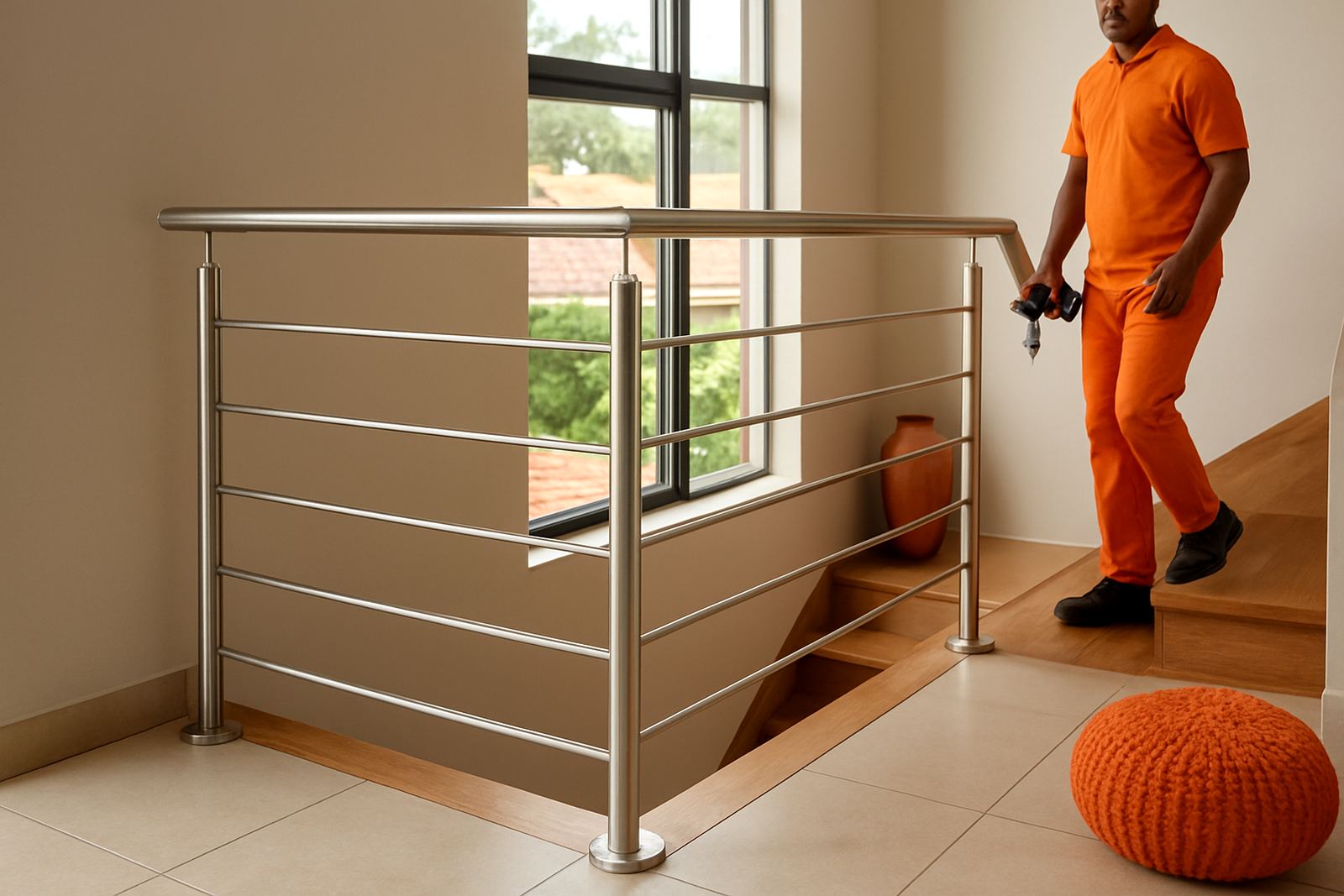
Landing rails are fixed safety barriers fitted where a stair run opens onto a landing, around a void, beside a drop, or along a raised walkway. They help guide people, reduce the risk of a misstep, and give a proper handhold where traffic is moving in more than one direction. In a home this might be the top of a staircase. In a guest lodge it may be a mezzanine or viewing deck. On a commercial site it can be a service platform or access route.
For Knysna and coastal Garden Route conditions, stainless steel is a practical choice because it holds up well against humidity, salty air and frequent cleaning. It is also a good fit where finishes must stay neat and easy to wash down. We make landing rails to suit the opening, the wall line, and the way people use the space, instead of forcing standard lengths into an awkward corner.
Typical sizes, tube options and fixing styles
Most landing rails are made to site, but common heights are 900 mm for domestic and light commercial use, and 1000 mm to 1100 mm where the rail forms a stronger barrier around public areas or raised access points. Upright spacing is usually kept tight enough to meet safety intent and reduce the chance of a child slipping through. Where a balustrade is needed instead of a simple handrail, we can build a fuller guard with mid-rails or infill sections.
- Tube sizes commonly used: 38 mm, 50 mm and 63 mm outside diameter for handrails
- Posts can be made from square or round tube depending on the look and loading needed
- Wall returns, end caps and corner bends can be added for safer grip
- Base plates, side-fix brackets and core-drilled posts can be used depending on the substrate
For a coastal property, hidden welds, neat corner returns and proper drainage at fixing points help the rail stay cleaner for longer. We also set the rail line so it clears doors, window sashes and other moving parts. A good rail should not crowd the space, it should sit naturally and feel solid in the hand.
Where landing rails suit best in the Garden Route
These rails suit a wide range of local sites from compact staircases in Knysna town to larger hospitality and marine-side properties in Plettenberg Bay and Mossel Bay. They are often used where there is regular foot traffic, changing levels, or a need to guide people safely through a raised area.
- Stair landings in homes, apartments and guest houses
- Raised walkways, decks and pool surrounds
- Mezzanines, lofts and storage platforms
- Office stairs, shop floors and workshop access points
- Boardwalk-style paths and sheltered outdoor passages
In wetter areas and places exposed to load-shedding, people often want a solution that does not rely on lighting alone for safety. A well placed landing rail gives a clear edge and a steady grip even when the power is off. It also helps when there are wet shoes, sand, or a crowd moving at once.
How we measure, fabricate and install landing rails
We start with site measuring so the rail follows the true line of the stairs, landing or edge. This matters because many openings are not square, and a few millimetres out can leave a rail looking off or causing a poor fit against tiles, plaster or concrete. After measuring, we prepare shop drawings where needed and confirm fixings, heights and any glass or hardware details before fabrication starts.
Fabrication is done in our Knysna Industria workshop. Depending on the job, we may weld, grind, polish and dry-fit sections before taking them to site for installation. Onsite installation can include drilling concrete, fixing to steel, setting posts into prepared pockets, and fitting the handrail line so it sits level and secure. If the job requires electrical tools, we can work off site power or generator power as conditions allow, and for marine fitouts we plan around weather windows and corrosion exposure.
Our team can also fit glass panels, gate hardware and other stainless components where the landing rail forms part of a larger safety or access system. If you need the rail matched to existing finishes, we can restore surface appearance so new work and old work sit together more neatly. Minor irregularities in old concrete or tile edges are common, so we allow for that in the fixing plan rather than trying to hide it later.
Care, cleaning and service checks for stainless rails
Stainless steel is low maintenance, but it still benefits from proper care. In coastal towns like Wilderness, Sedgefield and Knysna, salt in the air can leave surface marks if the rail is never washed down. A simple rinse with clean water and a soft cloth usually keeps it in good order. For fingerprints and everyday marks, a mild soap solution is normally enough.
- Check for loose fixings every few months, especially on busy stairs
- Wipe rails after heavy sea spray or when cleaning with harsh chemicals nearby
- Keep drainage points clear so water does not sit in brackets or base plates
- Look for scratches, dents or movement after a bump from furniture or trolleys
- Arrange maintenance checks where the rail is used by the public or in rental units
If a rail has surface staining, light marking or wear at the welds, we can inspect and advise on restoration or repair. Small issues handled early are usually simpler and cheaper than waiting until the fixing point has worked loose.
What to check before you order landing rails
Before we price or fabricate a landing rail, it helps to know the exact opening size, the height difference, and what the rail is fixing into. Concrete, brick, timber and steel each need a different fixing method. We also need to know whether the rail is for private use, guest use or general public access, because that changes the safety approach.
- Overall length of the landing or open edge in metres
- Finished floor level and the drop below the landing
- Preferred rail height and whether a top rail only or full guard is needed
- Fixing surface type and whether it is sound enough for anchors
- Any gates, glass infill, return ends or corner turns required
- Site location for access, transport and installation planning
It also helps to tell us if the site is in a coastal zone, a high-wear commercial area or a property with regular cleaning and maintenance staff. That way we can suggest the right tube thickness, finish and fixing detail from the start, instead of having to change the plan half way through the job.
Key facts
| Material | 304 stainless steel as standard, 316 stainless available for coastal and higher corrosion sites |
|---|---|
| Common rail heights | 900 mm, 1000 mm and 1100 mm to suit use and site conditions |
| Tube sizes | 38 mm, 50 mm and 63 mm outside diameter handrail options |
| Fixing methods | Base plate, side-fix bracket or core-drilled post fixing |
| Finish options | Brushed finish, polished finish or restored existing surface to match |
| Service area | Knysna, Plettenberg Bay, Sedgefield, Wilderness, George and Mossel Bay |